4 - Combat in detail
I've shared videos demonstrating Omen Dawn's combat gameplay with the expectation that what is presented by the game is self-explanatory enough, but it was inevitable that the game mechanics of combat would warrant a more in-depth description, since it's such an important part of the game, and since at this moment the work has progressed to an extent where I can speak more confidently. This discussion will build upon information given in blog #3. We'll start by going over the elements of the combat interface.
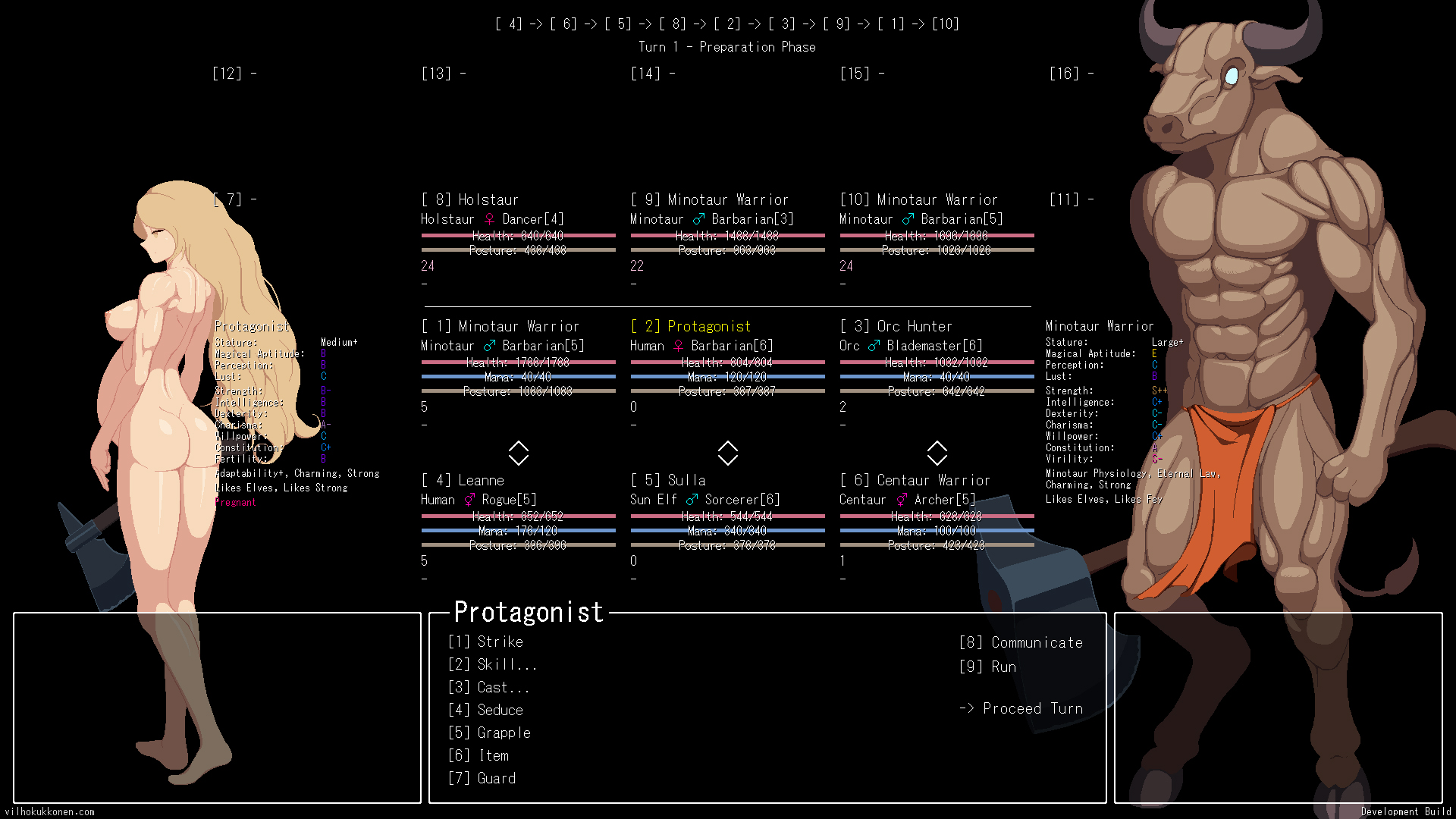
In the middle of the screen are sixteen field slots, with one trough six being the player's party, and seven to sixteen being the enemy side. Slots one to three and seven to eleven are considered front row, whereas the remaining are back row. Rows are a significant element of combat, with most actions targeting other characters having a limited range. On each slot is displayed the most basic information about the character occupying it. Skipping over what was introduced in the previous blog, there is a new game mechanic to introduce. Posture represents a character's firmness of foot. It can be reduced by being struck by attacks or certain spells, or whiffing melee attacks or grapple attempts. Upon reaching zero posture, a character will be staggered, being unable to act or evade for the remainder of the current turn and the next one, and being more vulnerable to health damage. Posture will reset to full upon recovering from stagger, supposing the character manages to survive. Posture also slowly regenerates at the end of each combat turn. Directly below the posture bar is a number showing the character's current arousal. In the case of a character being excluded from game mechanics relating to sexuality, an abomination of necromancy, for example, this number will not be shown. Right next to the arousal indicator will be shown combat statuses. There aren't any on these characters because nothing has happened yet, so we'll get back to that with the next screenshot. Below that will be shown the character's combat action. These labels are all blank, indicating that no action is selected yet. Actions selected by enemies will not be revealed to the player until they happen, but the action labels on the enemy side will show ongoing actions, such as being in a grapple. Between the player side front- and back row are buttons to issue a command for those characters to swap places. There is no way to shift position laterally during combat, so keep that in mind when deciding your party's formation. Clicking on a slot with the left mouse button selects the character, right-clicking deselects a character or an action, whereas right-clicking with nothing selected opens the status screen for that character. Even enemies can be inspected.
On the left and right of the field slots are shown additional information about a character upon being moused over. All of these were discussed in the description of the status screen. At the top of the screen is shown the initiative order of all active combatants, based on the character's dexterity, class skills, stature, equipment, and combat statuses. Most combat actions occur in the order determined by initiative. Below that is show the turn ordinal of the encounter. The first turn in considered to be "preparation phase", during which accuracy and damage are diminished, unless the character has the "Skirmishing" class skill, and grappling is not possible. The combat log is located at the bottom-left of the screen. It is empty at the moment because nothing has happened yet. At the bottom-right is the information panel, which shows information about selected combat actions. Between these panels is the action panel, where the player selects actions from. The protagonist was selected by clicking on her slot. Going over the buttons in order, first there is the attack quick select button. If a weapon with more than zero weapon skills is equipped to the right hand, or in the case that there isn't, the left hand, this will select the #1 weapon skill of that weapon. In the case that there are no weapon skills available, it will select the #1 intrinsic attack of the character. Intrinsic attacks come from the character's physiology, with humans, for example, having two: "Punch" and "Kick". The second button will open a sub-menu where any of the available weapon skills, intrinsic attacks, or class active skills can be selected. After that is the button to open the sub-menu to select spells or the counterspell action. More on magic in a future blog, because this one is already so long. Then there's the seduction action, which when used on a valid target will raise his or her arousal. The effectiveness of seduction is determined by several factors, including the seductor's charisma, outfit, and class skills, as well as the target's willpower, lust, and sexual proclivities. After that there's grappling, which is primarily used for fucking enemies into submission, but could also be used to temporarily restrain them to protect your other party members. The item button allows you to use items that are not equipment. A free hand is required to use items in combat. Guarding decreases posture damage taken, increases posture recovery, and increases the chance for an incoming attack to be blocked by a shield, if one is equipped. Characters will automatically guard if no action is selected for them before starting the turn. The communicate button opens a menu for communicating with the enemy side characters. Here you could attempt to convince an enemy to join you, more on this later, or to ask for surrender terms, which could result in more lenient consequences than if you were defeated outright. Beneath there's the button to attempt retreat, the success chance of which is based on the average initiatives of the opposing sides. Some encounters cannot be retreated from, and some enemies will not chase after you. The proceed turn button, as you could guess, starts the turn. Lastly, we get to the most important part of the combat interface: behind the other elements are the character sprites. The protagonist in slot [ 2] who I've selected being displayed on the left, and the minotaur in slot [10] who I had hovered my mouse cursor over being displayed on the right. The protagonist is wearing a light armor called "Raider Attire", but this is not shown because I haven't drawn the sprite yet.
Now that we've gone over the interface, let's talk about the encounter itself. I am fielding a full party of six characters, starting in order with Minotaur Warrior, a character who I recruited in to my party because the great strength and constitution of the minotaurs make them powerful frontliners. The barbarian class is the obvious choice for this race when considering the limited selection of weapons that can be held in his large hands. I also chose the barbarian class for the protagonist to make use of her strength and stature, while relying on evasion for protection instead of heavy armor that would compromise her seduction ability by covering her up. Orc Hunter is a character recruited early on whose class I changed to blademaster to have some damage type diversity in my frontliners. The blademaster class is similar to barbarian, but, as the name suggests, focused on swords. Leanne is a thief who tried to gank me in the early game who I recruited to pad out empty slots in the party. I was looking to replace her with a spellcaster, but the satyr I had captured and tied up was still refusing to join my crew. Sulla is an adventurer that I recruited right at the start. The first adventurer you hire costs zero money. This will be the case both in the demo and the full game. The sorcerer class, as you would expect, is focused on casting spells. Spellcasters are a valuable asset to a party, fulfilling many diverse functions too numerous to enumerate here. Centaur Warrior is an archer using ranged attacks to pressure the enemy from the relative safety of the back row. Each party member is wearing class-appropriate equipment, most of which was taken from previously defeated enemies because I haven't programmed the equipment shop yet.
Equipment, indeed, is very important to characters that can wear any. The right hand slot is used for holding weapons. Weapons have a multitude of characteristics setting them apart from eachother. Type ("Sword", "Axe", "Bludgeon", et cetera) and the [Exotic] tag define the class skills needed to wield the weapons to their full potential. Handedness defines whether the weapon can only be held with one hand, two hands, either one or two hands (using both hands allows for more powerful strikes), or to be equipped in the left hand slot. One-handing and two-handing also have their associated class skills. Strength requirement is the adjusted strength (intrinsic strength adjusted by stature, sexual dimorphism, and age multipliers) treshold needed to wield the weapon. If there are two tresholds, those are for two-handing and one-handing. A character's hands may also be too big or small to hold a given piece of equipment. The other tags beside [Exotic] are [Channel], which defines the equipment as a channeling device, which is necessary to be equipped in order to cast spells if the character doesn't have the racial ability to do so inherently, and [Back Row], which indicates that the weapon's skills can be used against enemies from the back row. A weapon has zero, one, or two weapon skills that can be used when wielding it. Weapon skills have the following characteristics: damage type, base damage (flat outgoing damage), strength- and dexterity multipliers (how much the wielder's effective attributes contribute to damage), posture multiplier (how much posture damage is dealt relative to the health damage), poise gain (more on this later), and accuracy multiplier. Accuracy for weapon attacks, intrinsic attacks, and class active skills depends on many more factors, including: effective dexterity, perception, class skills, equipment, combat statuses, traits, et cetera. Which is then compared to the defender's evasion, which is affected by a lot of the same factors. Some weapons have zero attacks because they are only used as channeling devices, but not all channeling devices are like this. Finally, a weapon may have special effects or stipulations, such as having a further damage bonus against staggered targets. As for the left hand slot, the only weapons that are equipped to it right now are "Longbow" and "Hunting Bow". You could have a bow in your left hand and a one-handed weapon in the right hand to have access to the skills of both, while losing the benefits of having a free hand (ability to use items and getting a bonus to grappling rolls). Besides bows you could also hold a shield in your left hand. Shields have passive chance to guard attacks, which activates a damage negation that is comparable to heavy armor. The "Knight Shield", for example, has a guard rate of 30% normally, and 70% when combat action is "guard". Outfits come in four types: clothing, light armor, medium armor, and heavy armor. Armors come with a set of damage negations, seduction penalty, evasion penalty, and accuracy penalty (reduced if character has the corresponding proficiency from class). Clothing, on the other hand, does not have any damage negation, but also no penalties, except seduction penalty. Characters wearing clothing type outfits can also benefit from the effect of "Unarmored Proficiency". Outfits also have a wide range of characteristics defining who can wear them, but beyond the ability to wear, there's also willingness. Some characters may be unwilling to fight without clothes that cover their crotches, and breasts, if applicable, or with clothes that are too slutty. This was not indicated in the status screen last time I showed it, but it is now.
Anyways, back to the encounter. My goal is to recruit the opposing minotaur in slot [10] because he, unlike the one in my party, has the "Strong" trait. I order my Minotaur Warrior to attack [ 9] Minotaur Warrior because his stature makes him a relatively easy target to hit despite the preparation phase accuracy penalty. Sulla also targets him with the Firebolt spell to start building Burn status early. I have Orc Hunter, Leanne, and Centaur Warrior target [ 8] Holstaur in hopes of further increasing my advantage in outnumbering the enemy quickly. Lastly, the protagonist targets [10] Minotaur Warrior for seduction.
The first turn goes well for me. Both arrows loosed at the holstaur find their mark, and so does Orc Hunter's blade, leaving her with 73 out of 640 health remaining. My minotaur's axe swing as well as Sulla's Firebolt also connect. The only succesfull attack by the enemy side is the holstaur swinging her glaive at the orc. I order Leanne and Centaur Warrior to finish off the holstaur, the protagonist to repeat the seduction action, and Minotaur Warrior, Orc Hunter, and Sulla to attack [ 9] Minotaur Warrior. As I start the second turn the holstaur is finished off and the attacks concentrated against the minotaur stagger him. Unfortunately, the other enemy minotaur manages to land a critical hit on Orc Hunter, downing him instantly.
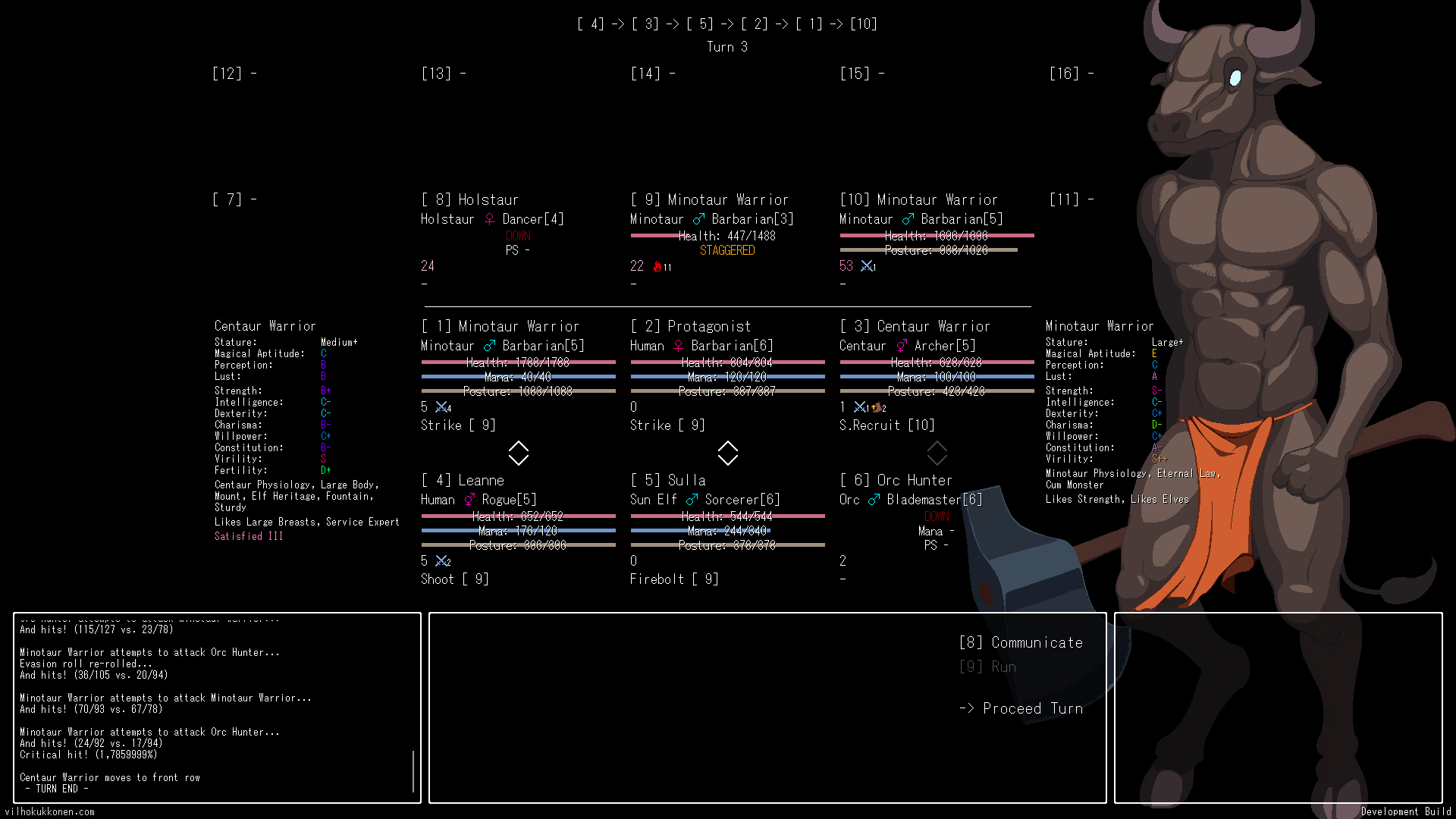
It's a good time to talk about combat statuses now that we have a screenshot that shows some. The flame represents "Burn" (Lose health equaling effect count at the end of each turn, then halve count. Max count: 99.), the boot with an up-arrow represents "Haste" (Increase initiative by 10% for each count. Max count: 10.), and the crossed swords represent "Poise" (Increase evasion, guard rate, grappling defense, critical chance, and posture recovery by +1% for each count. Can be spent to activate skills. Set to 0 upon being staggered. Max count: 50.). The burn was applied in conjunction with the heat type damage of Sulla's Firebolts, the poise came from successful weapon attacks (different attacks have different poise gain values, as mentioned before) and successful evasions, and the haste was applied to the centaur by the "Centaur Physiology" trait.
Now that victory is close at hand, I move to start attempting to recruit the minotaur. Recruiting works by selecting a recruiter, a target, and a recruitment method. When using regular recruitment, the chance of success is determined by the effective charisma and -intelligence of the recruiter and the target. Charisma is half as impactful if both are same sex. The minotaur also has the "Eternal Law" trait, which causes effective strength to also be factored in. Seduction recruitment is affected by these same factors, but there is also a bonus based on the target's arousal and preferences. This is why I had been targeting him with seduction. That and because arousal decreases outgoing melee damage. Successful seduction recruitment comes with the promise that the recruiter will breed with the target after the conclusion of the battle to complete the recruitment, thereby necessitating a character who can fulfill this promise to be the recruiter for this option to be available. Stipulations for recruitment to be available in the first place are that the enemy does not outnumber you, that the recruiter's class level must be at least equal to the target's, and that the target does not categorically refuse to be recruited. Recruitment can be attempted once per turn.
I decide to use seduction recruitment for the best odds. The only character in my party that is able to carry this out at the moment is Centaur Warrior, because the protagonist couldn't take the minotaur's massive cock right now due to her pregnancy, whereas he's too big for Leanne outright, at least for now. She manages to convince the minotaur to switch up on his day ones as the rest of my party slimes his friend, ending the combat encounter in player side victory on turn 3. Each party member earns 1003 experience points, and a glaive, a colossal axe, and a loincloth are made available to be taken as spoils from the two downed enemies. That went smoothly, too much so. Perhaps I shall make this encounter more difficult. The minotaur used the centaurs pussy afterwards as promised, but she didn't get pregnant this time.
Now that the encounter is over, let's go over some counterfactuals to discuss the remaining topics I want to cover. What if I had lost? There are various things that may happen upon being defeated depending on what the encounter is. In this case it would have been that the enemies would have taken turns using whomever they wanted. The same would have also been the surrender condition here. What if I couldn't have used recruitment because of, for example, level difference? An alternate way of getting enemies to join you is to use grappling. An enemy could be subjugated by grappling and fucking him or her right there in the middle of the battle. Normally a character needs a cock to be able to do this, but the protagonist is the exception, and this is the reason why this wouldn't have been an option in this particular encounter, since, as mentioned before, she was not able to fit the minotaur's cock in at that time, not to mention the issue of the minotaur being much stronger than her. Characters who are fucked into submission can then be taken captive, whereupon they must be further convinced before agreeing to join you. Be careful though, as the enemies may also try to grapple your party members if sufficiently sexually provoked. In the case that this happens, you could have another party member rescue the grapple defender by attacking the grappler, or the defender could attempt a grapple break or a grapple reversal.
Aside from magic, which will be the subject of another post, that should be everything important regarding combat, unless, God forbid, I'm forgetting something. This game is a work in progress, so anything described here could be subject to significant change. This is the reason I'm not describing any of the combat formulae in detail. You'll be able to learn about them from the in-game manual when you play it for yourself. I decided to write this blog now because the project has reached a state where I could start properly playtesting it. If I added in the boss encounter of the demo, it would be playable from start to finish, but the reality of the situation is not as impressive as this technically true statement suggests. There is still much work to be done.
- Vilho Kukkonen