3 - Status- and rest screens
Most of what I've shown about the game's mechanics have been about the combat, but there are other aspects to the game that are vital to tying the experience together into a cohesive whole. We'll start by taking a closer look at the character status screen, since as characters are what the game revolves around, this will give context to everything else.
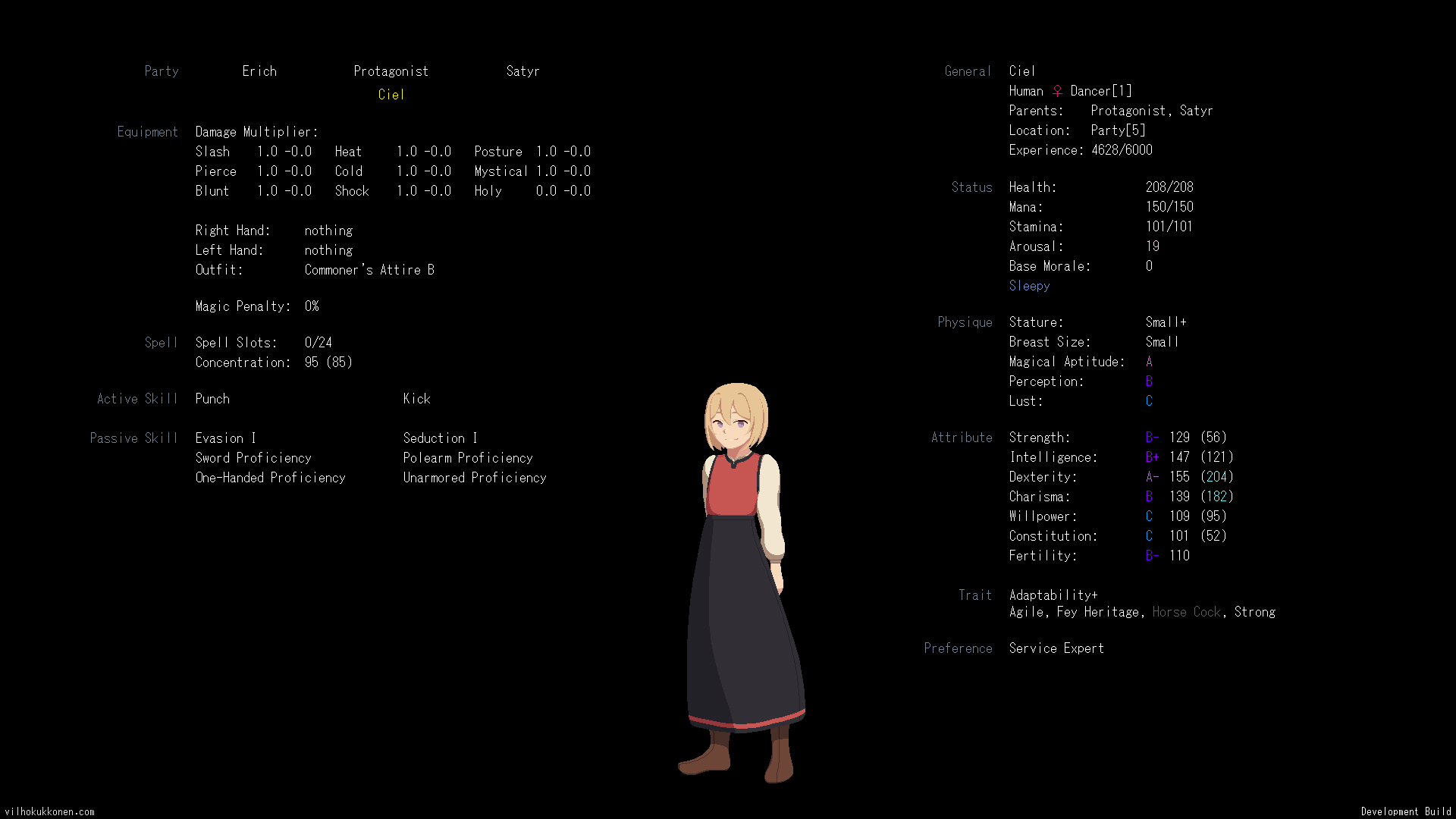
Starting from the top-right, self-explanatory basic information about the character is displayed. Enemies in combat can be inspected just the same as your own party members, in which case the character's name would be displayed in red, whereas captives are denoted by a blue name. Hovering your mouse next to the name will reveal the edit name button, which you can use to freely rename your party members by typing with your keyboard, or drawing a random name from the same lists that are used for procedural generation. Next to the race and sex is displayed the character's class and class level. Starting from level zero, a class can be chosen for a character upon earning enough experience (in the ways one expects for the genre) to reach level one. Each class provides different boosts to the character's attributes, passive skills with various effects, and active skills. These benefits are acquired progressively as the character's level increases up to the maximum of nine. Some classes have pre-requisites such as minimum attribute grades or sex restrictions. Some races are restricted to a certain class. And some classes are enemy only.
Moving on to the "status" section, you can see the most fluctuating variables of a character. Health is self-explanatory, but it bears mentioning that a character whose health is reduced to zero will be considered defeated until the end of a combat encounter, only being able to be healed by an outside of combat only spell, or sleep. Mana is a resource which is consumed to cast spells. A character whose mana is zero or less will be staggered and unable to act for each combat turn until getting back to a positive amount. Mana, unlike health, is regenerated on an hourly instead of daily basis. It can also be increased by shooting cum into the character's pussy or throat. This method can increase mana above the maximum, but the overflow will dissipate fairly quickly. Stamina is decreased by taking various actions in and out of combat, and like health, is also restored by sleeping. Very low stamina will cause the character to be staggered in combat, and be unable to perform certain actions. Below that is the character's current arousal, ranging from 0 to 100. High arousal will decrease a character's ability to deal damage or cast spells successfully, as well as potentially causing erratic behaviour. Morale is a variable that increases or decreases during combat based on things that happen, such as hitting an attack, evading, being hit, seeing allies be downed, et cetera, and affects various things to a modest degree. Basa morale is the amount that a character starts with at the beginning of a combat encounter, more on it later. At the end of this section can be seen statuses that are affecting the character currently. These are applied and removed in various ways, with some like "Sleepy" or "Tentacle Lubricant" being very transient, and some like "Pregnant" being active for a long time.
Next up we start looking at a character's intrinsic characteristics in the "physique", "attribute", and "trait" sections. Stature determines various things that one would expect, such as multipliers to certain attributes, and what outfits the character can equip. Breast size also affects the ability to put on some outfits, as well as potentially increasing seduction- or service performance. These two things usually change between childhood and adulthood. Magical aptitude affects various things related to spellcasting, such as maximum mana, spell power, and spell slots. Perception affects accuracy and critical hit chance, as well as the party's ability to spot things. Lust mainly affects arousal gain.
In the attribute section, there are two numbers next to the attribute's letter grade. The left one is the intrinsic number, which is fixed and is based on the character's race and traits. The right number is the effective attribute, which is modified by factors such as stature, sexual dimorphism, class attribute multipliers, and more. Each attribute is used extensively in calculations for various game mechanics in and out of combat in a way that should be logical and intuitive, so I'll skip over them for now and bring them up when they are relevant.
Traits may be the most significant thing that sets characters apart from eachother. At the start of the list we can see intrinsic traits, which are determined by the character's race, and allow the player to learn about the intrinsic characteristics of that race by reading the tooltips. These are followed by extrinsic traits, which are the genetic characteristics that a character is born with, and can pass on to offspring. The traits seen in this screenshot have the following effects:
Adaptability+: Receive additional bonuses from class level.
Agile: Increase Dexterity to next level.
Fey Heritage: If Magical Aptitude would have been lower than A, increase it by one level, otherwise, gain one bonus spell slot for each level of Magical Aptitude above B.
Horse Cock: Base Virility = S. Increase Lust by one level.
Strong: Increase Strength to next level.
A trait being displayed as grayed out means that it is inactive and having no effect (in this case because of the character's sex), but still able to be passed on to offspring.
Finishing off the right side of the screen, we have the character's preferences. The maximum amount is two, and in the case that a character has fewer than that, more can be cultivated trough experiences. These affect pretty much every mechanic that has to do with sexuality. The player will be asked to choose up to two preferences for the protagonist at the start of the game.
At the top-left of the screen are buttons to open the status screens for each character in your active party. Below that are the character's current damage multipliers for each damage type, with the first number being the character's intrinsic damage multipliers based on race, and the second one being subtractions or additions from armor. These are all zero in the screenshot because clothing that is not armor never provides damage negation. Below that is the character's current equipment. Clicking on the equipment slots opens a list of all the equipment of that category in your party's inventory, with items that cannot be equipped by that character grayed out. Lastly in the equipment section is magic penalty, which tells you how much all of the equipped equipment is cumulatively decreasing the character's spell power. A piece of equipment's magic penalty corresponds to its iron content.
Speaking of magic, the next section shows how many spell slots are taken up. Clicking this will bring up the interface to equip spells that are available to your party. Different spells take up different amounts of spell slots. The maximum slots is determined by magical aptitude, intrinsic (not effective) intelligence, the "Memory" class skill, and some traits. Equipped spells can be freely changed when resting. After that is the character's maximum concentration (corresponding to effective willpower), and current concentration, which is affected by arousal, stamina, and certain combat statuses. Concentration is a character's ability to cast spells successfully, with some spells being more difficult than others.
Finally there's the skills section, firstly showing active skills, that is skills that can be selected as actions in combat, which come from the character's physiology, equipped weapons, and class. Then there are passive skills, which have a wide range of effects that you'll get to familiarize yourself with when you play the game. All passive skills come from the character's class.
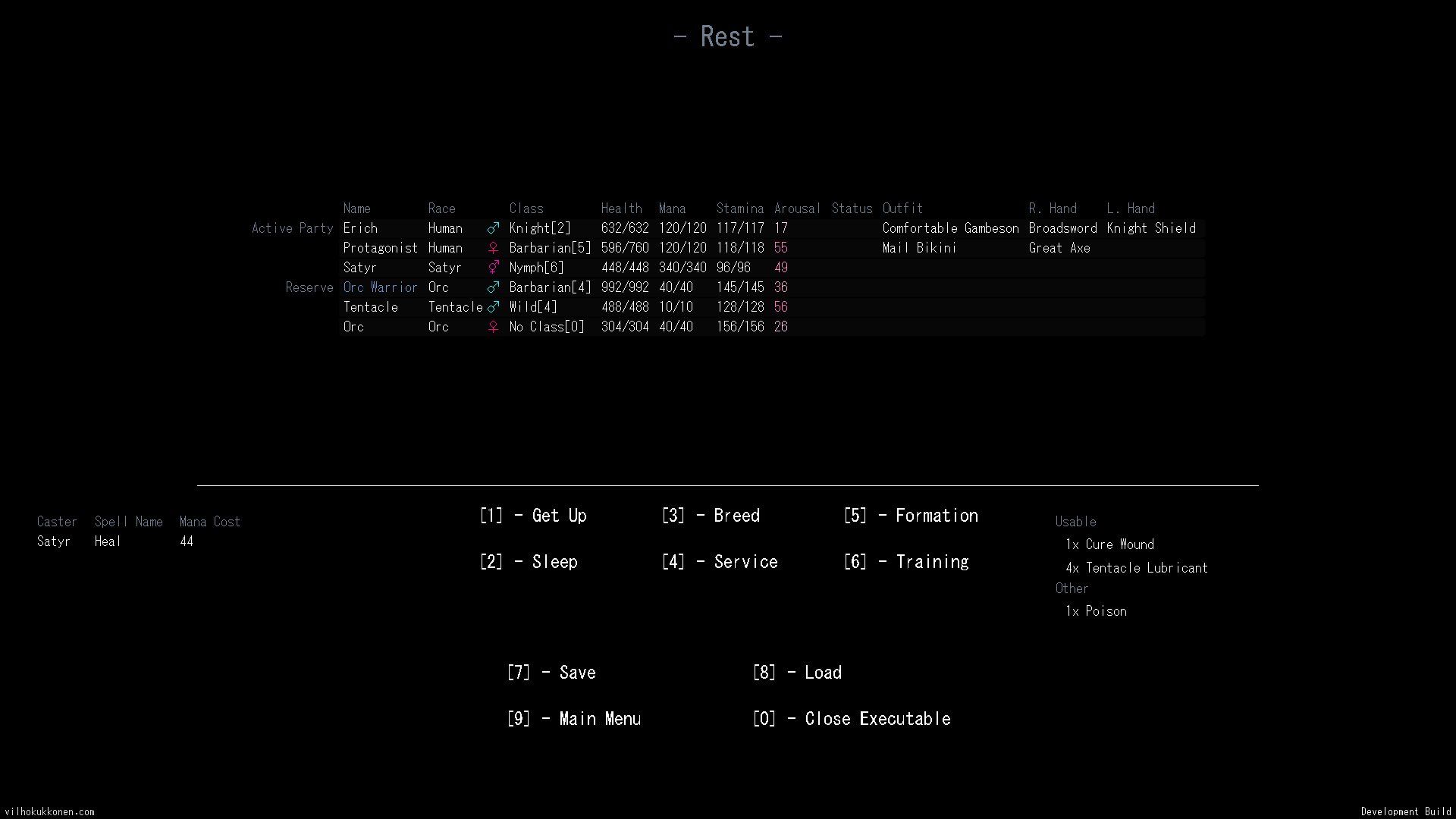
Another important interface in the game is the rest screen. The centerpiece is a list of all of the characters in your party. Clicking on a list item will open that character's status screen. On the bottom-left and bottom-right are buttons to use spells and consumable items outside of combat. In the middle below the character list are the button to stop resting and go to the overworld screen (or in the case of demo version 1, just the demo main screen), the button to go to sleep and advance time to the next day, the button to adjust your active party formation, the button to open the training menu, which is a catch-up mechanic for low class level characters to make it easier to change your team composition, and, of course, the breed and service buttons. Let's take a look at the breed interface now.
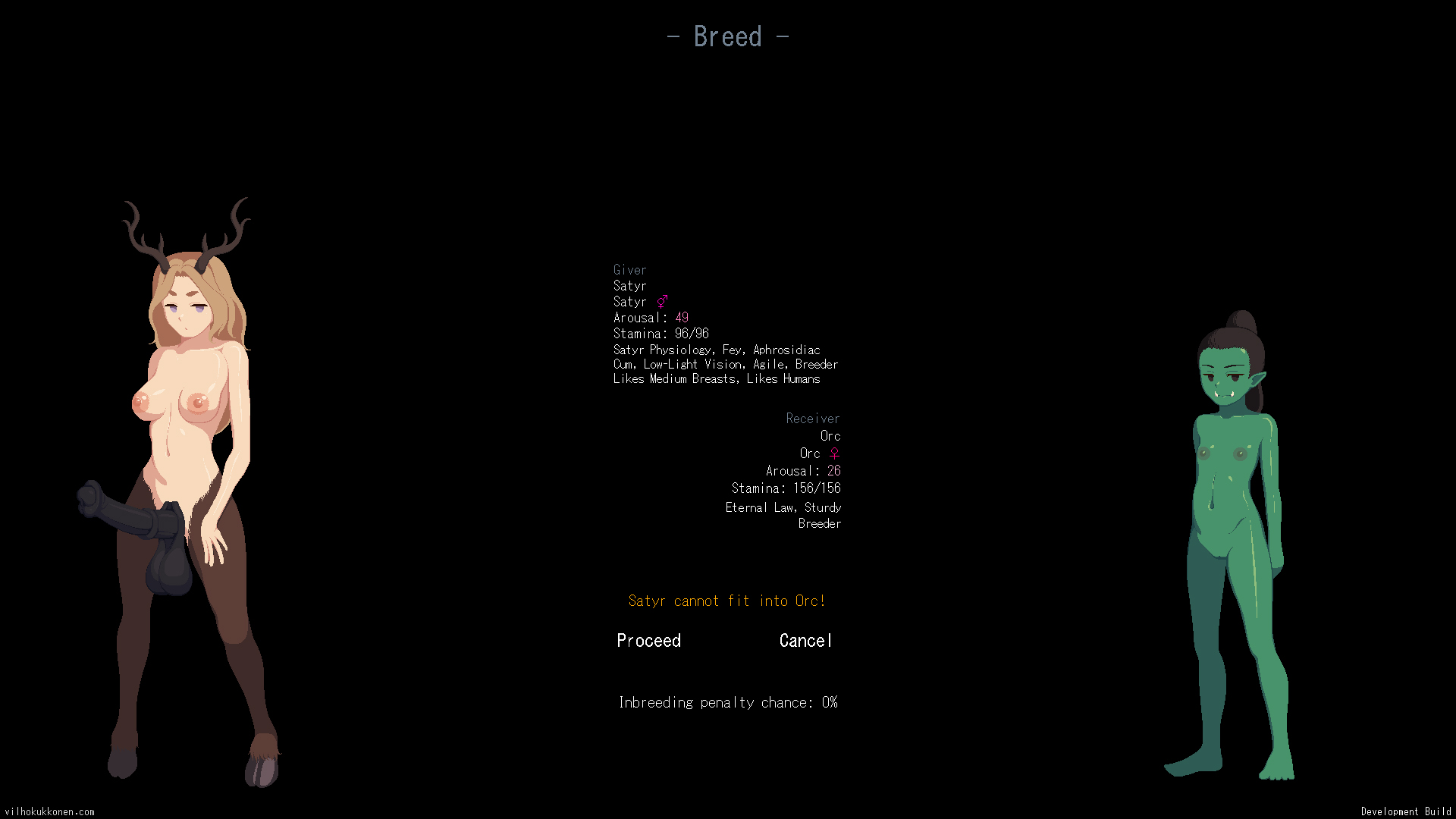
I select a pair of characters and press the proceed button, but an orange message pops up informing me of why the breeding couldn't be carried out. I swap in the protagonist to the receiver slot and try again.
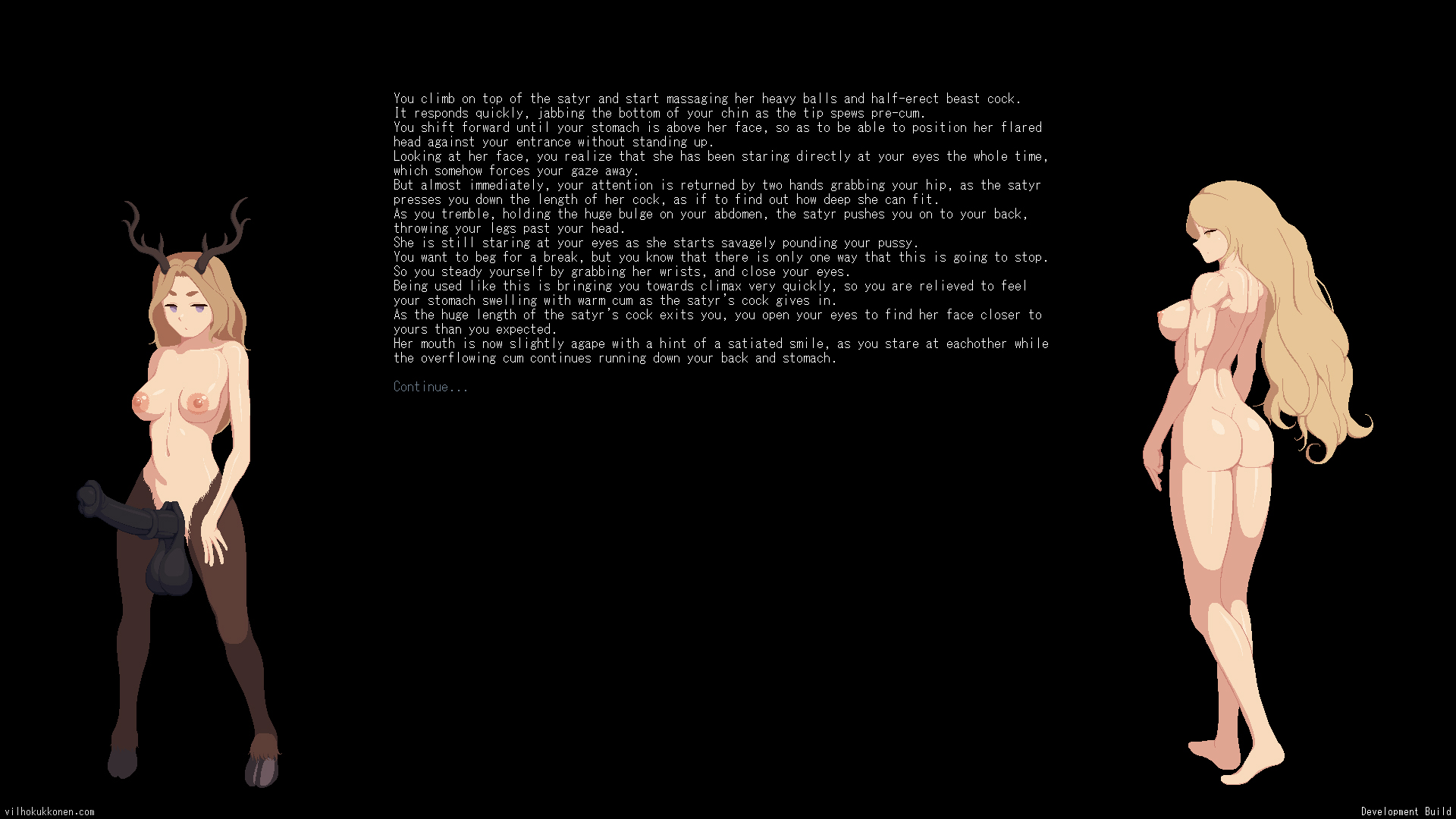
Sex scenes are described with prose that aims to maintain full immersion with variations based on the possible variable conditions presented by the game mechanics. Unique characters, especially the protagonist, have longer and more detailed scenes. The act of having sex has various effects, some depending on how enjoyable it was based on many factors. In this case, the "Satisfied" condition was applied to both characters, "Aphrosidiac II" was applied to the protagonist because of the effect of the satyr's intrinsic trait, their base morale was increased, arousal was reset, the receiver's mana was restored, and most importantly, the protagonist became pregnant. The chance of pregnancy occurring depends on the amount of cum emitted, which is based on the virility attribute, as well as fertility, which is the only attribute where higher grade means lower number, because it functions as a treshold. But the conception roll can only occur if the race pairing is valid in the first place. Some pairings result in offspring of the male's race, some in the female's race, some in a new race, and some have two possible outcomes. The amount of valid pairings vary greatly, ranging from humans having a very large amount, and the infertile half-elves having none at all. The child that resulted from this breeding is seen in the first image of this blog post. One more thing to mention about the breeding interface is the inbreeding penalty chance. This is the chance for the "Inbred" trait, which diminishes all attributes, to be added to the offspring. It's calculated by counting the amount of common ancestors for the two characters (tracked four generations up), multiplying this number by itself, then by 0.1, and that's the percentage chance.
The service interface looks almost identical, but in the place of the inbreeding penalty label is displayed the maximum service score for that pairing under the current circumstances. Unlike breeding satisfaction, which is deterministic, service results are based on a random roll ranging from 1 to the service score. Service can be a good alternative to breeding when one wants to avoid a pregnancy, unless...
- Vilho Kukkonen